A native macOS voice assistant in the spirit of Iron Man’s Jarvis — lives in the menu bar, hands-free voice loop, actually controls the Mac (open apps, type text, click mouse, drive Safari/Chrome tabs), and searches a personal RAG knowledge base.
Designed for real agentic flow: say “Open Safari and search Facebook” → Jarvis opens Safari → focuses URL bar → types → presses Enter. No hallucinated success.
At a glance
- Native Swift binary ~9MB, full DMG ~50MB — vs the Electron prototype at 1.5GB (170× lighter)
- 40 tools registered: Mac control (6) + browser Safari/Chrome (15) + input/keyboard/mouse (10) + KB search (2) + weather/maps (4) + on-device vision (placeholder)
- 3 switchable LLM backends: Cloud Haiku ($0.001/turn), Local Hermes 3 8B (free), Apple Foundation Models (macOS 26+)
- End-to-end voice loop <2s with Cloud Haiku: STT (~300ms) → LLM (~800ms) → TTS playback
- Continuous mode — auto-listens after each reply, interrupted by saying “stop” / “wait” / “cancel”
- Dictation hotkey Cmd+Shift+D — types into any focused field (replaces Apple Dictation, uses on-device SFSpeech)
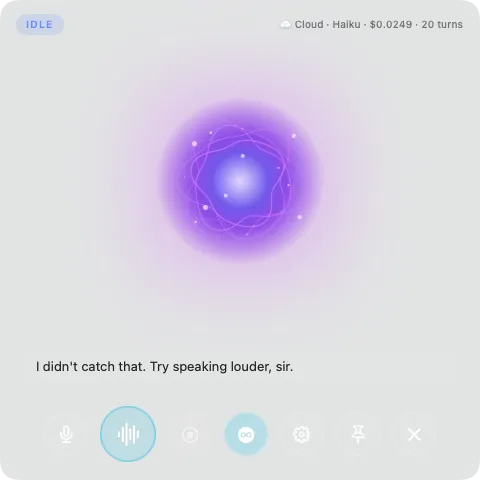
- Custom Siri-class visualizer — SwiftUI Canvas-based noise-displaced sphere, 3 styles switchable (Orb / Particles / Wave Rings)
- Privacy posture: audio + STT + KB + tool execution stay 100% on-device; only the transcript text leaves the device when Cloud LLM is selected
Stack
Swift 6.0 · SwiftUI · AVAudioEngine · SFSpeechRecognizer (on-device) · AVSpeechSynthesizer (Premium voices) · Anthropic Claude Haiku 4.5 · Ollama (Hermes 3 / Qwen) · Apple Foundation Models (macOS 26+) · NSStatusItem + NSPanel · Carbon RegisterEventHotKey · AXUIElement + CGEvent + NSAppleScript · Keychain Services
UX flow
Push-to-talk turn:
- User presses Cmd+Shift+J (global hotkey) or clicks the 🎤 button
- Floating panel appears, visualizer turns cyan (LISTENING)
- User speaks the command
- Energy-based VAD detects end-of-speech (700ms silence) → SFSpeech finalizes
- Visualizer turns amber (THINKING) — Claude Haiku invokes the tool sequence
- Visualizer turns green (SPEAKING) — AVSpeechSynthesizer plays the reply through a Premium voice (Ava/Zoe/Evan)
- Returns to IDLE; panel hides if user clicks ✕
Continuous mode: toggle the ♾️ icon → after Jarvis finishes speaking, listening auto-restarts after 400ms (delay to avoid feedback). Interrupt by saying “stop” or clicking ⏹.
Dictation: focus any text field → Cmd+Shift+D → speak the sentence → AX-paste inserts text directly (no clipboard pollution).
Architecture
┌─ Jarvis.app (Swift native, ~9MB) ──────────────────────────┐
│                                                             │
│  StatusBarController (NSStatusItem)                        │
│         │                                                   │
│         ▼                                                   │
│  FloatingPanel (NSPanel translucent + NSHostingView)       │
│         │                                                   │
│  ┌──────┴───────────────────────────────────────────────┐  │
│  │ SwiftUI: VisualizerView + Transcript + Controls       │  │
│  │   - JarvisOrb (Canvas multi-octave noise)            │  │
│  │   - ParticlesViz / WaveRingsViz alternatives          │  │
│  └───────────────────────────────────────────────────────┘  │
│                                                             │
│  ┌─ Voice loop ──────────────────────────────────────────┐  │
│  │  AudioEngine → SpeechRecognizer (SFSpeech) → ...     │  │
│  │  → ConversationEngine → LLMProvider                   │  │
│  │  → TTSEngine (AVSpeechSynthesizer)                    │  │
│  └───────────────────────────────────────────────────────┘  │
│                                                             │
│  ┌─ ToolRegistry (40 tools, async actor) ────────────────┐  │
│  │  MacTools · InputTools · BrowserTools                 │  │
│  │  KBTools · LocationTools                              │  │
│  └───────────────────────────────────────────────────────┘  │
│                                                             │
│  ┌─ LLMProvider protocol ────────────────────────────────┐  │
│  │  ClaudeProvider (URLSession + prompt caching)         │  │
│  │  OllamaProvider (Hermes 3 / Qwen)                     │  │
│  │  FoundationModelsProvider (macOS 26+)                 │  │
│  └───────────────────────────────────────────────────────┘  │
└─────────────────────────────────────────────────────────────┘

External:
  personal-rag-kb HTTP server :8080 (RAG over ~/Documents/KB/)
  Ollama daemon :11434 (local LLM)
No Python sidecar. Pure Swift binary. The KB server is just a separate HTTP endpoint the user runs.
Decision log
1. Native Swift over Electron
Started the prototype in Electron (Three.js visualizer + Python backend) — worked, but shipped a 1.5GB bundle. Rewrote native Swift over a weekend — 50MB, native macOS feel, no Python deployment headache.
2. Cloud Haiku is the default; Local is a fallback
Tested Qwen 2.5:7b and Hermes 3:8b locally for agentic tool-use. Both failed at multi-step chains (open_app + type_text + press_key). They confidently hallucinated “I typed Hello” without ever calling the tool. Switching to Claude Haiku → 100% accuracy at $0.001/turn.
→ Default Cloud, Local for privacy mode or chit-chat. Details: Local vs Cloud LLM blog post
3. Push-to-talk over wake word for V1
Always-listening “Hey Jarvis” is sexy in demos but in production:
- Battery drain 15–25% per day
- 2–5 false triggers per day
- Privacy concerns
V1 ships push-to-talk Cmd+Shift+J. Wake word ships in V1.5 with an openWakeWord local model.
4. SFSpeech over WhisperKit for V1
Whisper (via WhisperKit on the Neural Engine) has higher accuracy but:
- ~150MB model download on first run
- 5–8s cold start
- Cache management overhead
SFSpeech is on-device, free, instant, and accurate enough (90%+) for a voice agent. Will upgrade to WhisperKit in V2 if multi-language is needed.
5. Custom Canvas visualizer over metasidd/Orb
Tried the metasidd/Orb Swift package — pretty, but iOS-only (UIKit). Built a custom SwiftUI Canvas implementation: multi-octave noise sphere + sparkle particles + Fresnel halo glow. State-driven palette (idle blue → listening cyan → thinking amber → speaking green).
3 visualizer styles selectable by the user: Orb (default), Particles, Wave Rings.
Numbers
- Bundle: 9MB binary, 50MB DMG (vs Electron at 1.5GB)
- RAM: ~80MB resident steady-state, ~200MB during a turn
- Cost with Cloud Haiku + prompt caching: ~$0.001/turn × 30 turns/day = ~$1/month
- Latency end-to-end voice loop: ~1.5–2s (Cloud) / ~3–4s (Local)
- Tool count: 40 (Mac / Browser / Input / KB / Location)
Documentation
| Doc | Read this for |
|---|---|
| Blog post | Decision framework for product/CTO teams choosing between local and cloud LLM |
Out of scope V1 / roadmap V1.5+
- Vietnamese voice support (viXTTS or ElevenLabs Multilingual)
- User-specific voice cloning (F5-TTS)
- Always-on “Hey Jarvis” wake word
- Hybrid intent router (lightweight classifier routing Local vs Cloud)
- Persistent cross-session conversation memory (currently per-session)
- Apple Developer ID signing + notarization → ship a clean public DMG
- Computer-use vision (Anthropic Computer Use API or native screenshot+Claude vision)